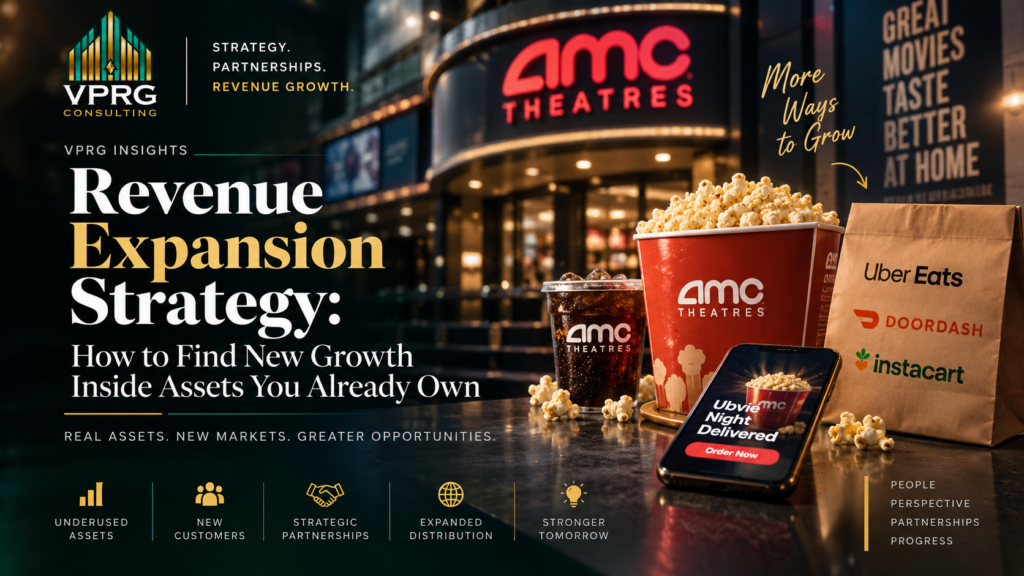
Your next revenue stream may already exist inside your business. The opportunity may not require building another product—it may require finding a new customer, distribution channel or strategic partner for an asset you already have.
When companies need growth, the instinct is often to create something new.
Launch a product.
Enter a market.
Increase advertising.
Hire more salespeople.
Build another service.
But revenue expansion does not always start with creation.
Sometimes it starts with reconsidering the value of what already exists.
VPRG Consulting Founder and CEO Christina Lindley recently contributed to a Food Institute article examining how movie-theater operators are extending their concessions businesses beyond the theater through delivery.
The article highlights a compelling example: AMC reported nearly 50% year-over-year growth in food-delivery sales, while its broader food-and-beverage business generated $923.4 million in revenue during the first half of 2026.
But the bigger strategic lesson extends far beyond movie theaters.
Theaters already had the kitchens.
They already had recognizable products.
They already had physical infrastructure.
They already had operating capabilities.
What changed was access to the customer.
Delivery platforms created another way for those existing assets to generate revenue.
That raises a question worth asking inside almost every business:
What do we already own, know, operate or have access to that could create value in a new way?
Read Christina Lindley’s insights in The Food Institute
What Is Revenue Expansion Strategy?
Revenue expansion strategy is the process of increasing revenue by finding additional ways to monetize a company’s existing customers, capabilities, products, relationships, intellectual property, distribution or other business assets.
It can include:
- Reaching new customer segments
- Entering new markets
- Adding distribution channels
- Developing strategic partnerships
- Creating complementary services
- Expanding an existing product into new use cases
- Increasing customer lifetime value
- Licensing existing capabilities or intellectual property
- Creating referral or revenue-share relationships
- Finding additional applications for existing infrastructure
The important distinction is that revenue expansion does not necessarily require starting from zero.
The business may already possess most of what it needs.
The strategic question becomes:
Where else can this create value?
Revenue Growth Doesn’t Always Require a New Product
Consider the movie-theater example.
Traditionally, the customer journey looked something like:
Buy ticket → Visit theater → Buy concessions → Watch movie
Food and beverage revenue was closely tied to physical attendance.
But the kitchen itself was capable of producing food whether or not the customer bought a movie ticket.
Separating those two things creates another possible journey:
Open delivery app → Order theater concessions → Consume at home
The underlying asset didn’t fundamentally change.
The distribution did.
That distinction is important because companies frequently confuse how an asset has historically been monetized with the only way that asset can be monetized.
Those are not the same thing.
Separate the Asset From Its Traditional Use Case
One of the most useful exercises in revenue strategy is to separate what a company owns from how it currently uses it.
A movie-theater kitchen does not inherently require a moviegoer.
A retail location does not inherently require every customer to shop inside the store.
A professional-services firm’s expertise does not inherently require one-to-one delivery.
A software company’s technology may solve problems outside the industry it originally targeted.
A proprietary dataset may create value beyond the product that originally generated it.
A customer relationship may create opportunities for complementary services.
A distribution network may have value to another company trying to reach the same audience.
The question is:
If we stopped defining this asset by its current use case, where else could it create value?
That is where revenue expansion often begins.
Distribution Can Unlock Latent Value
Businesses frequently assume that unlocking new revenue means building the entire customer journey themselves.
It doesn’t.
This is where strategic partnerships become particularly powerful.
Movie theaters do not need to build national food-delivery marketplaces from scratch.
Delivery platforms already have:
Customers.
Technology.
Ordering infrastructure.
Payments.
Logistics.
Consumer behavior.
Distribution.
The theater contributes something different:
Products.
Brand recognition.
Kitchen infrastructure.
Locations.
Operational capability.
Put the two together and an existing asset can reach customers it previously could not serve efficiently.
A useful way to think about this is:
Existing Capability × New Distribution = New Revenue Potential
That principle extends across industries.
A financial company can partner with advisers who already serve its target investor.
A healthcare business can work with attorneys or providers already interacting with its ideal customer.
A technology company can integrate with a platform its prospects already use.
A consumer brand can access customers through a retailer or marketplace instead of building every acquisition channel independently.
A consulting company can develop referral relationships with complementary service providers.
The right strategic partnership can allow a business to borrow distribution instead of building all of it itself.
The Best Partner Often Has What You’re Missing
A strong partnership is not simply two recognizable logos appearing next to each other.
The best partnerships combine complementary assets.
One company might have the product.
Another has distribution.
One has technology.
Another has customers.
One has expertise.
Another has market access.
One has credibility in a particular industry.
Another has a capability its customers need.
The strategic question becomes:
What do we have that another organization needs—and what do they have that would be expensive or difficult for us to build ourselves?
That is where partnership strategy begins to intersect with revenue strategy.
New Channels Create New Competitors
Expanding distribution can create opportunity.
It can also change the competitive environment.
Christina raises this issue in The Food Institute article when discussing theater concessions sold through delivery platforms.
Inside a movie theater, popcorn primarily competes with other theater concessions.
Move that same product into a delivery marketplace and suddenly the customer has an entire app of alternatives.
Pizza.
Burgers.
Desserts.
Convenience stores.
Restaurants.
Groceries.
The competitive set changed even though the product did not.
That is a critical lesson for any company entering a new channel.
New distribution changes context.
And context changes competition.
Before expanding into another channel, ask:
- What alternatives will customers compare us against?
- Does our pricing still make sense?
- Is the value proposition compelling in this environment?
- Does our brand carry enough weight outside the original context?
- What does the customer expect from this channel?
- Can our margins support the economics?
- What makes someone choose us instead of the alternatives immediately surrounding us?
A product that is compelling in one environment may become average in another.
Protect the Customer Experience When You Expand
Distribution is only valuable if the customer experience survives the transition.
A product designed for immediate consumption inside a theater may behave differently after sitting in a delivery driver’s car.
That sounds tactical.
Strategically, it is extremely important.
Christina specifically points to packaging and product experience in The Food Institute discussion, including the practical challenge of keeping delivered popcorn from becoming soggy.
The larger principle is:
Don’t expand distribution faster than you can preserve the value customers originally wanted.
Every new channel introduces variables.
Delivery time.
Packaging.
Presentation.
Customer support.
Pricing.
Returns.
Fulfillment.
Communication.
Expectations.
A business should evaluate the entire experience, not simply whether the product can technically be sold through another channel.
Revenue Expansion Has to Make Economic Sense
New revenue is not automatically good revenue.
A channel can increase gross sales while damaging margins.
That’s why revenue expansion should be evaluated economically, not just strategically.
Before launching a new channel, understand:
Incremental revenue
How much additional revenue could the channel realistically produce?
Incremental cost
What additional labor, commissions, technology, packaging or operational costs are required?
Margin
What remains after the channel’s costs?
Cannibalization
Will customers shift purchases they would have made through a more profitable channel?
Customer acquisition
Does the channel introduce genuinely new customers?
Lifetime value
Can those customers become more valuable over time?
Operational capacity
Can the business support additional volume without degrading its core operation?
A new revenue channel should create economic value, not merely activity.
Use the New Channel to Strengthen the Core Business
This is where revenue expansion becomes particularly interesting.
A new channel does not have to exist separately from the original business.
It can feed it.
In The Food Institute article, Christina suggests theaters could potentially use delivery purchases to encourage future theater visits through credits or rebates.
That’s a much more sophisticated strategy than simply:
Sell more popcorn.
Now the model becomes:
Delivery customer → theater incentive → physical visit → concession purchase → loyalty → repeat
The new channel becomes part of a larger revenue ecosystem.
That same principle can be applied elsewhere.
A digital experience can generate physical visits.
A partnership can generate direct customers.
An event can generate sales conversations.
Content can generate partnership opportunities.
A referral relationship can create customers who later purchase additional services.
A marketplace can introduce consumers who eventually buy directly.
The best growth systems create loops, not isolated transactions.
The VPRG Revenue Expansion Test
When evaluating an existing asset for new revenue potential, VPRG recommends looking at six dimensions:
1. ASSET
What do we already have?
Look beyond products.
Consider:
Customer relationships.
Technology.
Data.
Expertise.
Brand equity.
Physical locations.
Distribution.
Content.
Intellectual property.
Infrastructure.
Vendor relationships.
Industry access.
Communities.
2. AUDIENCE
Who else could benefit from it?
The current customer may not be the only customer.
Look at adjacent industries, use cases, demographics, business functions and stages of the customer journey.
3. ACCESS
Who already reaches that audience?
Instead of assuming you need to acquire every customer yourself, identify companies, platforms and organizations already trusted by that market.
Those relationships may become strategic distribution partners.
4. EXPERIENCE
Can we preserve the value in the new channel?
If the product, service or customer experience deteriorates during expansion, the new revenue may damage the brand.
5. ECONOMICS
Does the opportunity create attractive incremental revenue?
Understand margins, partner economics, acquisition costs, operating requirements and long-term value.
6. LOOP
Can the new channel strengthen the existing business?
The strongest revenue expansion strategies often create reciprocal value between channels rather than forcing them to compete.
Put together:
Asset → Audience → Access → Experience → Economics → Loop
That’s the difference between finding another place to sell something and building a thoughtful revenue-expansion strategy.
Strategic Partnerships Can Accelerate Revenue Expansion
Partnerships become especially valuable when the opportunity is clear but the company is missing one critical ingredient.
Maybe you have the product but not distribution.
The expertise but not audience access.
The technology but not industry credibility.
The customers but not a complementary capability they need.
The infrastructure but not enough utilization.
Building the missing piece internally may take years.
A partnership can sometimes close that gap considerably faster.
But the partnership still needs:
Mutual value
Aligned incentives
Clear economics
Defined ownership
Operational execution
Measurable outcomes
Otherwise, a promising partnership remains a conversation rather than becoming a revenue channel.
How VPRG Helps Companies Identify New Revenue Opportunities
VPRG Consulting works with founders, executives and growth-stage companies to identify commercial opportunities and build the strategy, relationships and execution required to capture them.
Depending on the engagement, that can include:
Revenue Expansion Strategy
Evaluating existing capabilities, markets, customers and assets to identify additional revenue opportunities.
Strategic Partnerships
Finding organizations that can provide distribution, customer access, complementary capabilities, credibility or market leverage.
Business Development
Opening conversations with relevant decision-makers and advancing qualified commercial opportunities.
Market Expansion
Evaluating where an existing offering may create value with new audiences, industries or geographies.
Partnership Structure
Developing referral, performance, sponsorship, co-marketing, revenue-share or strategic relationships around aligned economics.
Sales & Growth Optimization
Identifying where friction across positioning, distribution, customer acquisition or conversion may be limiting revenue.
The objective is not simply to create more activity.
It is to identify where existing business strengths can be converted into new commercial value.
Your Next Revenue Stream May Already Be Inside the Business
Growth does not always require another product.
Another team.
Another major capital investment.
Or another business entirely.
Sometimes the opportunity already exists.
The business simply hasn’t looked at the asset from the right angle yet.
Ask:
What do we already have?
Who else could value it?
Who can help us reach them?
Can we deliver it without compromising the experience?
Do the economics work?
Can the new channel strengthen the core business?
Those questions can reveal opportunities that are considerably closer than the company realizes.
Because sometimes the fastest route to new revenue isn’t building something new.
It’s unlocking more value from what you’ve already built.
Christina Lindley Featured in The Food Institute
VPRG Consulting Founder and CEO Christina Lindley recently contributed her perspective to The Food Institute’s examination of how movie-theater companies are extending concessions beyond traditional theater visits through delivery.
Her commentary explores the revenue opportunity created by existing kitchen infrastructure, the competitive realities of entering delivery marketplaces, preserving product quality and using new channels to strengthen the traditional theater business.
Read “Movie Theater Concessions Find New Fans – at Home” in The Food Institute
Looking for new revenue opportunities inside your existing business?