
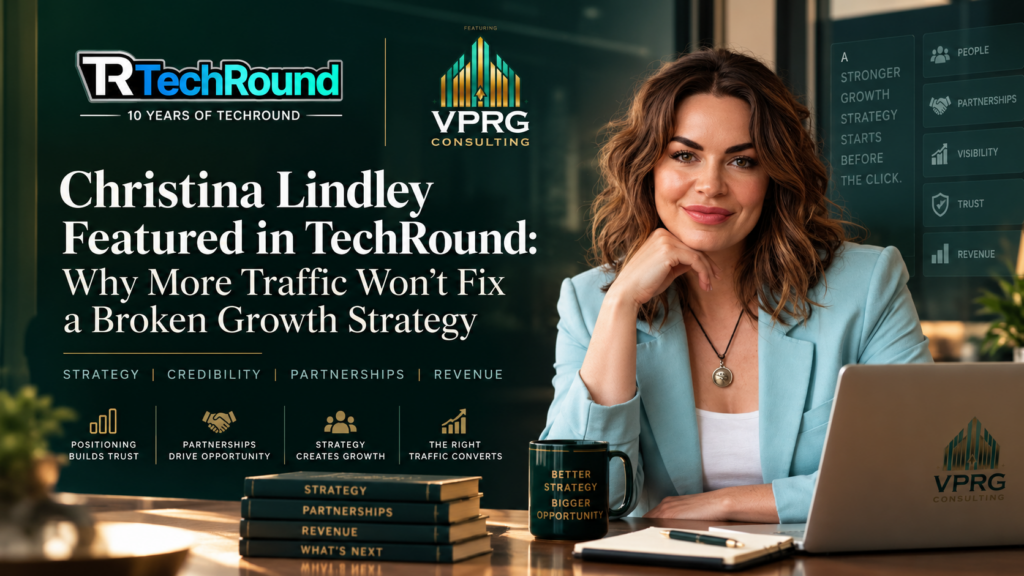
Paid advertising can accelerate growth. But if your positioning, credibility and conversion strategy are weak, buying more traffic may simply expose those weaknesses to more people.
VPRG Consulting Founder and CEO Christina Lindley was recently featured in TechRound’s Quite Contrary series, joining business and marketing leaders in a debate over whether companies and agencies rely too heavily on Google Ads.
Christina’s position goes beyond paid advertising:
The problem isn’t Google Ads. The problem is paying for attention before you’ve built enough trust to convert it.
Before increasing acquisition spend, companies need a compelling reason for customers to choose them, evidence that supports that promise, and a commercial system capable of turning attention into revenue.
That means getting the sequence right.
Positioning → Proof → Trust → Distribution → Conversion → Scale
Paid acquisition can accelerate that system.
It should not be expected to replace it.
Read Christina Lindley’s contribution in TechRound
Traffic Is Not the Same as Growth
One of the easiest mistakes in growth strategy is confusing activity with business outcomes.
More website visitors can be useful.
More impressions can increase awareness.
More clicks can create opportunities.
But none of those metrics necessarily mean the business is growing.
Traffic is an input. Revenue is an outcome.
Between the two sits an entire commercial system:
Attention → Relevance → Trust → Action → Conversion → Revenue
When that system works, increasing qualified traffic can create significant leverage.
When it does not, increasing traffic can simply increase the number of prospects who encounter unclear positioning, insufficient proof or a weak reason to buy.
This is why acquisition strategy should not begin with:
How do we get more traffic?
A better question is:
What happens when the right prospect arrives?
If the answer is unclear, increasing advertising spend may not solve the underlying growth problem.
Paid Acquisition Amplifies What Already Exists
Paid media is powerful because it provides distribution.
It can put a company in front of potential buyers quickly, test offers, create demand and accelerate a proven customer-acquisition system.
But amplification works in both directions.
Strong positioning becomes more visible.
So does weak positioning.
A compelling offer reaches more prospects.
So does a confusing one.
A credible company gets more opportunities to convert.
An unconvincing company pays to send more people toward something that is not yet working.
That is why VPRG views paid acquisition as part of a broader growth system, rather than the growth strategy itself.
Before significantly increasing distribution, companies should understand:
- Who they are trying to reach.
- What commercial problem they solve.
- Why their solution is meaningfully different.
- What evidence supports their claims.
- Why a prospect should trust them.
- What action the prospect should take next.
- Whether that journey reliably creates qualified opportunities.
Once those fundamentals work, paid acquisition can become an accelerator.
Before they work, it can become an expensive diagnostic tool.
Trust Has to Come From Somewhere
Customers rarely make meaningful purchasing decisions because they saw an advertisement once.
They look for signals.
Who has worked with this company?
What results has it produced?
Who recommends it?
Where has its leadership been featured?
Does the company understand my problem?
Do credible people or organizations trust it?
Does its expertise appear consistent across the places I research it?
This is why credibility has become such an important component of modern growth strategy.
In her TechRound contribution, Christina points to several ways companies can build that confidence, including organic search, useful content, partnerships, press, referrals, reviews and trusted communities.
These channels do more than generate awareness.
Together, they create evidence.
A prospect may first discover a company through Google.
Then visit LinkedIn.
Then read a founder interview.
Then notice a recognizable partnership.
Then review customer feedback.
Then return to the website.
Then book a call.
The conversion may ultimately be attributed to one channel.
The trust required to produce it may have been built across six.
That distinction matters.
One Strategic Partnership Can Create More Than Reach
Companies often evaluate growth channels primarily by audience size.
But reach and influence are not the same thing.
A strategic relationship with an organization your target customer already trusts can create something advertising has to work much harder to manufacture:
Transferred credibility.
Christina makes this point in TechRound, noting that she has seen a strong partnership create more confidence than months of simply publishing content.
That is one reason strategic partnerships can become such powerful growth assets.
The right partnership can create:
Distribution — access to an established audience.
Credibility — association with an organization people already trust.
Revenue — direct commercial opportunities.
Market access — entry into customers, industries or channels that were previously difficult to reach.
Compounding value — introductions, referrals and opportunities that emerge from the initial relationship.
This does not mean every partnership is valuable.
Logo collecting is not a partnership strategy.
The relationship needs a clear commercial rationale and enough mutual value for both organizations to invest in making it work.
But when that alignment exists, partnerships can become considerably more than another acquisition channel.
They can become a strategic advantage.
Fix the Sequence Before Increasing the Spend
The question is not whether companies should use paid advertising.
For many businesses, they should.
The more useful question is:
When is the business ready to amplify?
VPRG looks at the growth sequence this way:
1. Positioning
Can the right customer immediately understand what you do, who you help and why it matters?
2. Proof
Can you substantiate the promise through results, expertise, customer relationships, testimonials, third-party recognition or other credible evidence?
3. Trust
Does the prospect have enough confidence in the company and its leadership to continue the conversation?
4. Distribution
Can you consistently reach the people most likely to value the offer?
This can include search, content, partnerships, referrals, outbound business development, communities, earned media and paid acquisition.
5. Conversion
Is there a clear path from interest to qualified conversation to commercial opportunity?
6. Scale
Once the economics and conversion process work, where can additional investment create disproportionate growth?
The order matters.
Companies frequently try to solve stages one through three by spending more aggressively at stage four.
That is where acquisition costs can become painful.
The Best Growth Strategies Combine Channels
There is another trap in the debate between paid and organic growth:
Treating them as opposing philosophies.
They are not.
Strong growth systems rarely depend on a single channel.
Organic search can capture existing demand.
Thought leadership can demonstrate expertise.
Earned media can build third-party credibility.
Strategic partnerships can create distribution and trust.
Referrals can produce high-intent opportunities.
Business development can create conversations with specific decision-makers.
Paid acquisition can accelerate reach.
The question is not:
Which one channel wins?
It is:
Which combination creates the strongest path from market attention to commercial outcome?
That is a fundamentally different way to think about growth.
Instead of optimizing isolated marketing metrics, leadership begins designing an interconnected revenue system.
Build Something Worth Amplifying
Before asking how much more traffic the business can acquire, ask whether the business has created something worth sending that traffic toward.
Is the positioning sharp?
Is the offer relevant?
Is there credible proof?
Does the market trust the company?
Are the right relationships in place?
Is there a clear conversion path?
Can sales capitalize on the demand being created?
Can the organization execute after the deal closes?
If those answers are strong, additional distribution can become powerful.
If they are weak, more traffic is unlikely to be the complete solution.
Growth does not come from attention alone.
It comes from connecting attention to trust, trust to opportunity and opportunity to revenue.
How VPRG Helps Companies Build Growth Systems That Convert
VPRG Consulting works with founders, executives and growth-stage companies to identify where commercial opportunities exist and build the strategy, relationships and execution required to pursue them.
Depending on the engagement, that can include:
Revenue Growth Strategy
Identifying new revenue channels and determining where resources can create the greatest commercial return.
Strategic Partnerships
Developing relationships that can create revenue, distribution, credibility, market access or other strategic advantages.
Business Development & Deal Flow
Building targeted pipelines and advancing qualified opportunities with relevant decision-makers.
Market Positioning & Expansion
Strengthening how a company communicates its value and identifying opportunities to enter new markets or customer segments.
Sales & Growth Optimization
Finding the gaps between attention, opportunity and conversion that may be limiting revenue.
The objective is not simply more activity.
It is to build a commercial system capable of turning the right attention into the right opportunities—and the right opportunities into measurable business outcomes.
Growth Starts Before the Click
Google Ads, SEO, content, partnerships, PR, referrals and outbound business development are all tools.
None of them can replace the fundamentals underneath them.
The companies best positioned to scale are the ones that first understand:
Who they serve.
Why they matter.
Why the market should believe them.
How they create value.
And how attention becomes revenue once they earn it.
Build that system first.
Then amplify it.
Christina Lindley shares her perspective alongside other business and marketing leaders in TechRound’s Quite Contrary discussion about Google Ads, organic growth and customer acquisition.
Read the full TechRound feature
Ready to build a stronger revenue and growth strategy?